Tuesday, January 3, 2012

Paul Robeson--"A socialist society represents an advance to a higher stage of life!"

 "Once he did not exist
But his voice was there, waiting.

Light parted from darkness,
day from night,
earth from the primal waters.

And the voice of Paul Robeson
was divided from the silence."

From-Ode to Paul Robeson
By Pablo Neruda, Translated by Jill Booty


There can never be enough said or written about the tireless and heroic feats achieved by the monumental Paul Robeson, artist, socialist, freedom fighter and friend of all workers everywhere.  Robeson's life and the example he led is just as inspiring today for new generations as it was in his own time.  His early life is described here by the Bay Area Paul Robeson Centennial Committee:
"Paul Robeson was a famous African American athlete, singer, actor and advocate for the civil rights of people around the world. He rose to prominence in a time when segregation was legal in America and black people were being lynched by white mobs, especially in the South.

"Born on April 9, 1898 in Princeton, New Jersey, Paul Robeson was the youngest of five children. His father was a runaway slave who went on to graduate from Lincoln University, and his mother came from a family of Quakers who worked for the abolition of slavery. His family was familiar with hardship and the determination to rise above it. His own life was no less challenging.

"In 1915, Paul won a four-year academic scholarship to Rutgers University. In spite of open violence and racism expressed by teammates, Robeson won 15 varsity letters in sports (baseball, basketball, track) and was twice named to the All American Football Team. He received the Phi Beta Kappa key in his junior year, belonged to the Cap & Skull Honor Society and was the Valedictorian of his graduating class in 1919. However, it wasn't until 1995, nineteen years after his death, that Paul Robeson was inducted into the College Football Hall of Fame.

"At Columbia Law School (1919 to 1923), Paul met and married Dr. Eslanda Cordoza Goode, who was to become the first black woman to head a pathology laboratory. He took a job with a law firm, but left when a white secretary refused to take dictation from him. He decided to leave the practice of law and use his artistic talents in theater and music to promote African American history and culture."

Robeson rose to international prominence as a premier singer and actor, breaking the race barrier in acclaimed appearances all over the world.  However, his early life experiences with racism and labor injustice impelled him to fight in even wider arenas than the theater.  In his biography titled Here I Stand, Robeson cites the words of abolitionist Wendell Potter,  “...I would come to learn in my own way, the great truth he spoke of when, after chattel slavery was abolished, he joined the fight for Labor’s emancipation: 'When I want to find the vanguard of the people I look to the uneasy dreams of an aristocracy and find what they dread most.’” (Paul Robeson, Here I Stand, 1958)

Henry Winston, National Chairman of the Communist Party, USA, writes of Paul Robeson in his hard-hitting text Strategy for A Black Agenda, comparing the deeds of Robeson to the pioneering work of Frederick Douglass:

 "In our time, the towering figure of Paul Robeson has personified the link between two significant periods--from the betrayal of Reconstruction to the era of Black liberation begun with Martin Luther King and the Civil Rights Decade.
"Frederick Douglass had himself been a slave and Robeson is the son of a slave. Like Douglass in his time, Robeson has devoted his life to the cause of Black liberation. And like Douglass, he recognizes that Black liberation cannot be achieved via a separatist path, but through Black power in alliance with the oppressed and exploited of all colors. Robeson has always seen Black independence and Black-white alliance as related, indispensable components of the liberation struggle...

"Robeson struggled for self-union of his people at home and for solidarity with the oppressed and their allies at home and abroad. Whereas Douglass travelled widely in Europe to win support for the anti-slavery cause, Robeson travelled even more extensively, rallying support for Black liberation from imperialism everywhere.

"That Robeson’s travels were more extensive than Douglass’ was of course made possible by the October Revolution, which replaced the czar and serfdom with socialism, opening the way for the end of racism and oppression in a major part of the globe, and becoming the most decisive support for the oppressed and exploited throughout the world."  (Henry Winston, Strategy For a Black Agenda, 1973 )

"Democracy cannot survive in a racist America"  (Paul Robeson, Here I Stand, 1958)


Paul Robeson found that while he was lauded abroad for his achievements in countries like the USSR that had organized their society into socialism, he was persecuted at home in the US by the oppressive and racist forces that struck against his Black people and laborers alike, of all colors.  His studies of socialist countries and socialist writing caused him to firmly link the source of injustice in the US to the forces of monopoly capitalism:  “Increasingly it is becoming clear that the main roadblock to social progress in our country-for labor, for education, for public health and welfare-is that very group which stubbornly opposes equal rights for Negroes...the upholders of ‘state’s rights” against the Negro’s rights are at the same time supporters of the so-called ‘right-to-work’ laws against the rights of trade unions.”  (Paul Robeson, Here I Stand, 1958)

Robeson spoke up with clarity for the solution: “On many occasions I have publicly expressed my belief in the principle of scientific socialism, my deep conviction that for all mankind a socialist society represents an advance to a higher stage of life-that it is a form of society which is economically, socially, culturally, and ethically superior to a system based upon production for private profit...the development of human society-from tribalism to feudalism, to capitalism, to socialism-is brought about by the needs and aspirations of mankind for a better life.”

In the US, the fight against racism is strongly tied to the fight against capitalism and the struggle for workers' unity and socialism. Karl Marx, in writing of the racist slave society of early America proclaimed:  "Labor cannot emancipate itself in the white skin where in the black it is branded." (Marx, Capital, 1867, Vol.1.) "Marxism-Leninism shows that racism is an obstacle to class unity, " said Henry Winston (Class, Race and Black Liberation, 1977).  Comrade Winston also wrote: “Lenin tirelessly emphasized that the struggle for democracy is indivisibly bound up with the struggle against racism, and class and national oppression...The history of this country has been warped and distorted, first by slavery, then the survivals of slavery and the ceaseless propagation of racist ideology.”  The ideals set forth by the founding fathers for the United States are made reality in the movement to eliminate racism and economic injustice.   “As Lenin persistently emphasized, the fight for democracy is at the heart of the class struggle"  (Henry Winston, Strategy for a Black Agenda, 1973) 

William Z. Foster also illuminated the basis of the anti-racist people's force which is the chief foe of racist monopoly: “The workers, as Lenin points out, develop bourgeois democracy to the utmost, and then make the leap to Socialist democracy. The fight for socialism is a struggle, by democratic means, for the highest form of democracy, which is completely unachievable under capitalism.”

“These democratic freedoms the working class also struggled to establish, defend and expand; but it fought, too, for its own specific democratic demands-higher wages, shorter hours, popular education, Negro people’s rights, the right to organize and strike, social insurance, protection of women and children in industry, etc. to all of which, historically, the ruling class has been opposed. These working class demands, fundamentally different in substance from the limited democracy of all American bourgeois leaders past and present, are the roots within the framework of capitalism, of what will eventually mature under socialism as proletarian democracy.” (William Z. Foster, History of the Communist Party USA, 1947)

In 1951, Paul Robeson and William L. Patterson took bold action to bring the staggering racism in the United States to a world stage.  They submitted the document "We Charge Genocide" to the United Nations, signed by many stalwarts in the movement for justice.  

“Out of the inhuman Black ghettos of American cities,” the introduction began, “out of the cotton plantations of the South, comes this record of mass slayings on the basis of race, of lives deliberately warped and distorted by the willful creation of conditions making for premature death, poverty and disease … ”

"Jarvis Tyner, executive vice chair of the Communist Party USA, says the power of the petition was its expose of culpability in genocide by the ruling circles in the U.S. “The federal government claimed it had nothing to do with the lynchings. But this petition said: ‘You knew about it and you did nothing. You knew about the super-exploitation and inhuman hardships inflicted upon the Black people and you did nothing. Your inaction, your indifference in the face of oppression means that it was policy.’”

"Among the signers were the eminent African-American historian and freedom fighter Dr. W.E.B. DuBois, George Crockett Jr., later a distinguished judge in Detroit who went on to serve many terms in the U.S. Congress, New York City Communist councilman Benjamin J. Davis, Jr., Ferdinand Smith, Black leader of the National Maritime Union, Dr. Oakley C. Johnson of Louisiana, Aubrey Grossman, the labor and civil rights lawyer, and Claudia Jones, a Communist leader in Harlem later deported under the witch-hunt Walter-McCarran Act. Also signing were family members of the victims of “legal lynching”: Rosalee McGee, mother of Willie McGee, framed up on rape charges, and Josephine Grayson, whose husband, Francis Grayson, was one of the Martinsville Seven, framed and executed on false rape charges in Virginia.

"In the section titled “Evidence,” hundreds of cases of lynching were documented. The petition charged that since the abolition of slavery at least 10,000 Black people had been lynched. The full number, it stated, will never be known because the murders were often unreported...
"...The “prime mover” in the genocide against the African-American people “is monopoly capital,” the petition charged. “Monopoly’s immediate interest is nearly four billions of dollars in superprofits that it extracts yearly from its exploitation and oppression of the Negro people …” The racist wage differentials inflicted on Black workers drives down the wages for workers of all races, the petition charged. Despite gains for the African-American people, that wage differential continues today to pour tens of billions in extra profits into corporate bank accounts each year."("We Charge Genocide:  the cry rings true 52 years later", Tim Wheeler, People's World, Feb. 2003)

"A Democracy cannot exist without labor unions"   (Paul Robeson, "Negroes should join the CIO", 1940) 
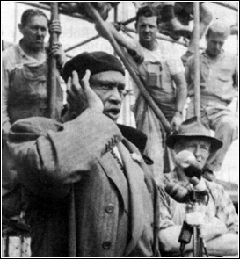

The freedoms that Robeson used his voice to establish and protect still have far-reaching effects today.  He worked endlessly in the Civil Rights movement and in the labor movement, putting his views into action in supporting and advising unions and workers all over the world.   Union brother Fred Hirsch records the lasting impression of Paul Robeson on organized labor:

"Robeson didn't have to look far to become a partisan of workers and, with that, of the trade union movement. The most important person in his life was his father. His father was a minister, but before that, a slave, a worker in the most abject of American working class conditions.

"At fifteen years old Robeson's father ran away from his owner to join the Northern forces, to work and fight to eradicate slavery. Young Paul respected his father more than any person in the world. In the late forties I listened in awe when Robeson spoke of how his "people freed the mules and left their plows and their cotton sacks to rot in the furrows where they dropped. They put down their baling hooks, their hammers and saws. They stopped making the things and wealth the slave owners needed to supply their armies. It was the biggest strike of workers ever seen on this continent. Thousands of Negro slaves made their way across the South to fight against slavery and win that great war." (paraphrased) Paul traveled far from the soil from which he sprang. He left his legacy in that soil and that soil never left his soul...

"...Here on the West Coast Robeson helped shape the ILWU into a conscious bulwark of affirmative action. ILWU leader Eddie Tangen told of Robeson's guidance to show that "the fight for Negro rights was a special problem and needed special solutions...Paul very forcibly brought to our attention that the whole fight had to be led by Negroes..." When Tangen, a white man who had led fights against racism, said: "I understand the problem, why can't I lead?" Robeson told him, "You're not Black, that's why." After brooding on that, Tangen stepped aside so that Joe Johnson became the Sec.Treas. of the whole union, an affirmative action landmark." ("Paul Robeson and Labor", Fred Hirsch, AME-Zion Church, San Jose, CA, 12 March 1999)

In 1943, Paul Robeson was made an honorary member of the ILWU.  Legendary Longshoreman leader Harry Bridges remarked, "Robeson frequently spoke and performed before ILWU members." (International Longshoremen's and Warehousemen's Union, from Paul Robeson: Tributes and Selected Writings, Paul Robeson Archives, NY, 1976).

 
"Robeson makes no bones about his friendship with the Soviet Union"-Benjamin J. Davis, Political Affairs, Apr. 1958

"So, through my interest in Africa I came to visit and to study what was going on in the Soviet Union.  I have told many times how pleased I was to find a place where colored people walked secure and free as equals."  is how Robeson modestly tells the story of his beginning of a life-long and reciprocated affection between himself and the Soviet Union in Here I Stand.  He would go on to champion the socialist state's fight against fascism, and was on the forefront of artists who raised funds to aid in the Great Patriotic War (WW2) against Hitler imperialist reaction.


"The acquaintance with the life of Soviet People greatly influenced the formation of Paul Robeson's political views, the development of his class consciousness and the molding of a convinced champion of freedom for his black fellow-countrymen.  Communism stopped being something vague for him.  Studying the life of the society whose friend he had become, Robeson saw that the ideas of the great philosophers of Marxism had brought freedom and equality to the life of the Soviet people.  As Paul himself said, it was here that he had found the right way of struggle for the equality of nations..."

"...Paul Robeson has become a character in some plays by Soviet playwrights, while a mountain summit in the Western Tyran-Shan and Trans-Ili Ala Tau mountains in Central Asia has been named after him.

"Paul Robeson is very near and dear to Soviet people."   ("Paul Robeson:  great friend of the Soviet peoples", Slava Tynes)
About the all out people's war against the criminal fascist front of monopoly, Robeson clearly stated:  "But in Britain the umbrella of appeasement that was held high by Chamberlain did not obscure the portents seen in the skies by the common people, and everywhere they rallied for anti-fascist action...And so it was that I, as an artist, was drawn into that movement and I came to see that the struggle against fascism must take place over every other interest. " (Paul Robeson, Here I Stand, 1958)

These are just a few highlights in the life of a deathless warrior for socialism and justice.  Whether it was on the international stage calling for peace, or at the gates of the White House demanding justice for African-Americans, or in the halls of workers, bringing words of solidarity, Paul Robeson personified the statement penned by Lenin: ‘All democracy consists in the proclamation and realization of rights which under capitalism are realizable to only a very small degree and only relatively. But without the proclamation of these rights, without a struggle to introduce them now, immediately, without training the masses in the spirit of struggle, socialism is impossible.’ ” (Lenin, Collected Works, v.23, p.74)
 

The words of Paul Robeson ring true for us today: “...we must go all-out to rally not tens of thousands but hundreds of thousands in a demonstration that will show that we really mean business...Our speakers should go to the White House and to congress and, backed by the massed power of our people, present our demands for action. Then they should come back to the assembled people to tell them what “the man” said, so that the people can decide whether they are satisfied or not and what to do about it.” (Paul Robeson, Here I Stand, 1958)


"You,
Paul Robeson,
defend man's bread,
honor,
fight,
hope.
Light of man,
child of the sun,
our sun,
sun of the American suburb
and of the red snows
of the Andes:
you guard our light.

Sing,
comrade,
sing,
brother of the earth,
sing,
good father of fire,
sing for us all..."

From-Ode to Paul Robeson
By Pablo Neruda, Translated by Jill Booty


Sunday, October 9, 2011

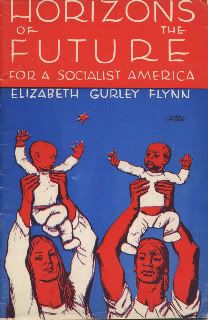
Elizabeth Gurley Flynn-- “Here is where I belong!”: The Communist Party of the USA

“America needs socialism. It has outgrown capitalism. All the patching and stretching will not make capitalism fit the America of today and tomorrow”

-Elizabeth Gurley Flynn, “Horizons of the Future for A Socialist America”, 1959


Elizabeth Gurley Flynn was a gallant fighter for workers and justice as a girl of 13 up until her passing in 1964 while holding the position of National Chairwoman of CPUSA.  She was a living embodiment of the history of American Socialism and Communism, starting her career as "Rebel Girl" agitator extraordinaire of the I.W.W., presiding over legendary labor strikes: “In 1913 I was a leader in the Paterson, New Jersey silk strike; in 1916, in a strike of the iron ore miners on the Mesaba range in Minnesota, where the mines are owned by the U.S. Street trust... I saw workers clubbed, beaten and shot down." (Elizabeth Gurley Flynn, Statement at the Smith Act Trial, 1951)

She tells here of her life-changing decision to enter the ranks of the Communist Party, USA on the eve of the heroic fight against world-wide fascist oppression in 1936: 

"George Dimitroff was a Bulgarian Communist who had been in exile in Germany and while there was framed in the infamous Reichstag fire case. Dimitroff was freed. He took refuge in the Soviet Union, where he delivered this speech in 1935 at the Congress of the Communist International. It is an eloquent and dramatic appeal to fight fascism, which he describes as the most vicious enemy of mankind. It is addressed to Communists especially and other progressive people elsewhere, to put aside all immediate partisan or sectarian interest or differences or ultimate political aims to unite to stop fascism. We will prove that this is what is meant by “united front.” This policy brought Communists together with all other honest and patriotic people who were determined to save their country from the ravages of fascism. We will show that Hank Forbes, one of our party organizers who might otherwise be here as a defendant, lost his life at the Anzio Beachhead in pursuance of that policy, as did hundreds of American Communists in World War II.

I resolved when I read this powerful appeal, “Here is where I belong. As soon as I am well I will again apply to join the Communist Party.” I did so. William Z. Foster, whom I first met in 1909 in the I.W.W., and Ella Reeve Bloor, whom I knew from the old Socialist Party, presented my application in the winter of 1936 and 1937. It was accepted and publicly announced in the press.”

Flynn's time in the ranks of the I.W.W. had exposed her to the thousands ills of capitalism, however their policy of non-political organizing and adherence to decentralized governance showed the flaws of this pursuit as the momentum of this phase of the labor movement withered away.  The passionate Rebel Girl of yore set her sights still further, with the help and guidance of the clear-headed and sure footing of Marxism-Leninism.


“This science of Marxism-Leninism, which is expounded in the books as evidence had its origin over a century ago with two great political thinkers, Karl Marx and Frederick Engels...(who) declared that what happens to humanity is not a matter of blind fate nor the will of great men, nor must it be accepted as irrevocable. They said mankind can find a scientific explanation for wars, famine, economic depression and poverty, and that mankind, especially the working class, can help to change society, can alter and direct the course of history, can abolish these evils and institute a planned social order, based on the well-being of all. Out of their profound analysis of all human history, and especially of its present stage known as capitalism, they developed the system of scientific socialism...”

Marxist-Leninist writings today fill thousands of books in all known languages...they are studied by millions of people throughout the world, but we will prove to you that these great beacon lights are not blueprints, are not hard-and-fast directives but are only a guide, modified to conform to the developments of history and to new social conditions. Programs, immediate programs are their application.” --
(Elizabeth Gurley Flynn, Statement at the Smith Act Trial, 1951)


After the defeat of the fascist Axis powers by the victorious   Allies, with the warm and heroic support of the Soviet Union, Flynn again took up her pen, writing this time to address the domestic struggles against monopoly, hunger, racism, and  economic injustice that still  raged on the home front.  She lent her wisdom in making clear the efforts, conflicts, and rights of women under capitalism in America.  Women helped win the war  and deserved a better life than a return to silent drudgery in the home.  Sister Flynn used the occasion of International Women's Day of 1947 to show the clear links of all forms of oppression under capitalism:

Communists Want Socialism

Sometimes I am sure you ask yourself, "When will it all end, when will we be able to live peacefully, happily, with work and plenty for all?" It is an important question to ask ourselves. It is a hope of women around the world.

I am writing this pamphlet as a daughter of a Socialist and suffragist, as an American woman who has been active in the labor movement for forty-one years, and as a Communist. (Don't go away. Remember Red-baiting, union smashing, anti-Semitism, and racial "superiority" theories are the pattern of the Nazis.) We Communists believe it is possible to have a system of society with peace, work, and abundance for all—Socialism. We believe in fighting hard to hold every gain made by the unions and the people generally in their democratic struggles. But we go further. We believe in the abolition of capitalism. It is no more the last word in human progress than was savagery, barbarism, or feudalism. To finally solve the economic and political problems of the American people, we believe we need Socialism. It will abolish private ownership by a few, men and women, of the land, natural resources and the industries of our country, which they use to make tremendous profits on the labor of others without working themselves.

Crimes of Capitalism

Our country is beautiful, our people are capable. But its vast resources and its people are exploited by a handful of greedy monopolists. Their crimes are innumerable. They allow veterans to remain homeless, children to starve around the world, miners to die in the depths of the earth. The capitalist system causes war, unemployment, depressions, prostitution. It takes advantage of colonial people, depriving them of independence. It helped build up the Nazis and fascists through international trusts (cartels). It is now building up Germany and Japan as buffers against the Socialist country— the Soviet Union. It deprives youth of education and self-development. It has kept women in an inferior position, has not safeguarded maternity or childhood, nor taken drudgery out of the home (except for its own women). It pits people against each other on the basis of sex, color, religion, national origin. It has created the Jim Crow system against the Negro people, that disgraces us everywhere. It retards the full use of the resources of our country, of inventions, and the benefits of science for health, and progress. It cramps the intelligence and cheapens the cultural life of our country.

Get Ready for 1948

We know the majority of the American people are not yet convinced, as we Communists are, that this is all true. Meanwhile we Communists do not place ourselves apart from the masses of people nor wait for them to agree with us, before we work together. Irrespective of what views honest and progressive people may have on Socialism, they do not constitute a bar to unity for all our immediate and important daily struggles. We have no interests separate from the welfare of the people of our country, of which we are a part. Communists are workers, farmers, housewives, veterans, Negroes, professionals—a cross section of our population. We engage actively, with other like-minded people, in struggles against that which oppresses these groups. Communists are producers, consumers, parents, voters, and as such join together with others who have the same interests—for higher wages, housing, education, against the high cost of living and to unite all progressive forces for the critical election of 1947 and 1948. These elections will be a show-down, we hope a defeat for those who represent Big Business (monopoly capital), who would enslave the American people and hurl us into an atomic war. To support those who fight these dangerous reactionary forces, progressive men and women candidates who stand for democracy at home and friendly relations with other countries, is our common obligation for the elections ahead. 

Women, 46 million eligible voters in our country, have a great responsibility. They have a tremendous political power to put our country in the vanguard of human affairs or to turn it in the direction of fascism. The Communist Party of the U.S.A. greets the women of America on International Women's Day in 1947, and expresses its confidence in their understanding and devotion to the cause of peace, for the American standard of living, for the rights of labor and the people generally. We believe that the great mass of American women can and will do their duty in the grave political struggles ahead, that our country and its people will be saved from the disaster of fascism. Let us all pledge, in keeping with the fighting tradition of International Women's Day, the annihilation of all open or disguised fascist ideas, tendencies and policies in our country.”  - Elizabeth Gurley Flynn, Women’s Place In The Fight For a Better World, 1947

 
In this pamphlet,  Sister Flynn evokes the wisdom of Lenin, who firmly stated  "Unless we learn to apply all the methods of struggle, we may suffer grave and sometimes even decisive defeat, if changes beyond our control in the position of the other classes bring to the forefront a form of activity in which we are especially weak. If, however, we learn to use all the methods of struggle, victory will be certain, because we represent the interests of the really foremost and really revolutionary class, even if circumstances do not permit us to make use of weapons that are most dangerous to the enemy, weapons that deal the swiftest mortal blows. Inexperienced revolutionaries often think that legal methods of struggle are opportunist because, in this field, the bourgeoisie has most frequently deceived and duped the workers (particularly in "peaceful" and non-revolutionary times), while illegal methods of struggle are revolutionary. That, however, is wrong."  Left-Wing Communism: An Infantile Disorder, V.I. Lenin,  1920

  American Communists use their resources and analysis to preserve and strengthen the working class:   “We Communists have never believed, as many of our forerunners did, that it is necessary to wait for socialism before all wrongs could be righted and all grievances settled. We have fought injustice, cruelty, violence, oppression, wherever it existed and against those responsible”  -Elizabeth Gurley Flynn, “Horizons of the Future for A Socialist America”, 1959
  
Not long after this, Sister Flynn entered the fight of her life, against the lies and accusations of the capitalist courts of the US, under the Smith Act, which charged several of the leaders of the Communist Party, USA with a desire to overthrow the American government by force.  Elizabeth Gurley Flynn delivered an address to the courts in an eloquent defense of the beliefs and tasks of CPUSA:

"We will prove that what is called capitalism has existed only a comparatively short time in the United States, less than two centuries, and it is not identical with government. It is neither the first nor the last stage of human society. Only those who profit by it consider it the Alpha and Omega, the best of all possible conclusions.

Before capitalism there was feudalism, when the feudal lords owned the land and lived on the labor of their serf.

Before that there were chattel slavery, barbarism. Capitalism developed and supplanted feudalism. With the advent of power-operated mass production machinery, it expanded rapidly, controlled by an ever-smaller group as free competition was replaced by monopoly.

When we speak of abolishing capitalism, we do not mean of course to abolish the rich natural resources of our country, nor the vast productive industries which have been developed by the labor of its people. We will prove that we mean abolishing the private ownership of the basic means of production and the profit-making system it engenders, which permits a few, the capitalistic class, to exploit the many.

We mean that the natural resources, and the mines, mills, factories, railroads, means of communication, shall be owned in common by all the people as state property to be administered by a government representing the working class, as well as all other people.

We don’t mean that personal or private property is abolished in those things which are the result of saving or for personal use. What will be abolished is the use of private property to exploit the labor of another. For example, in a socialistic society the principle applied would be from each according to his ability to each according to this work, which is identical with what St. Paul said to the Thessalonians, that if any would not work, neither should he eat.


In a Communist society, as differentiated from a socialistic society, when an abundance of everything needed for human life, development and comfort is assured, the principle would then be from each according to his ability, to each according to his needs.


This will be Communism, the fulfillment, we believe, of an ideal human society, which we believe to be possible and desirable.

In answer as to how we expect socialism will be brought about, in contradiction to the theory of force and violence, we will prove, as I have said, it cannot be the result of our efforts alone but it can be the result of the action of the majority of the people of the United States when they are ready and willing to make such a change.

Here, as in England and elsewhere, we Communists strive for a peaceful road to Socialism. We will show that we would do everything in our power to prevent the use of force and violence in establishing Socialism, which we know full well cannot be undertaken here or elsewhere unless it has the support of the majority of the people. But we cannot, of course, guarantee that the enemies of the people will accept the decision of the people to move to Socialism. Socialism, however, is not yet on the order of the day, let me repeat, in the United States. The immediate political program of our Party, we will prove, is anti-war and anti-fascist, for a people’s front government, a government dedicated to assure the well-being of the people. What will take place after that along the road to Socialism in the United States of America is something history and the American people will determine, but which no one can here blueprint.” -(Elizabeth Gurley Flynn, Statement at the Smith Act Trial, 1951)


This tireless fighter for socialism was eventually cleared of all seditious charges and lived to see the end of prosecutions of Party members under this terrible and suppressive law.   Sister Flynn passed away after a life of service to humanity while abroad in the USSR.  Her life and achievements were celebrated by the Soviets with a procession in her honor in Moscow.  By her request, she rests in the Forest Home Cemetery in Cook County, Illinois with the Haymarket Martyrs,  Emma Goldman, William "Big Bill" Haywood, Lucy Parsons and other comrades in struggle. 
 
“The future will be the reward for us all. On our 40th anniversary we of the Communist Party, USA say proudly, in the words of Gabriel Peri, editor of L’Humanite’, the French Communist newspaper, who was executed by the Nazis: ‘If it had to be done all over, I would take this road again.’”

-Elizabeth Gurley Flynn, “Horizons of the Future for A Socialist America”, 1959 


Enjoy the song "Rebel Girl" written for Elizabeth Gurley Flynn by labor martyr Joe Hill.  This video features a recorded introduction of Sister Flynn speaking of the origin of the song.   


Song "Rebel Girl" in the YouTube video sung by Hazel Dickens.

Thursday, September 8, 2011

William Z. Foster: 'Lenin Cleared the Road for Socialism in America!'

Comrade Lenin of Russia
Rises in the marble tomb
On guard with the fighters forever -
The world is our room!

- Langston Hughes, Ballad of Lenin


Lenin put American Communism on a rock hard scientific footing.  Daniel Mason reports that "The interplay between Lenin and the United States was very extensive. Lenin had learned the English language early in his career and became an avid student of US economics, politics, education and social life." (He Changed The World! foreword to Lenin's Impact on the United States, edited by Daniel Mason and Jessica Smith, New World Review, NY, 1970)
 
Confusion and utopian schemes ruled during the wilderness years of the American Left.  Lenin's writings and warm personal contact with US comrades swept away this discord.  Early Party luminary William Z. Foster evokes the bombshell effect of Leninism on the course of his own political maturity:   "after more than 20 years of intellectual groping about, I was at last, thanks to Lenin, getting my feet on firm revolutionary ground."  (William Z, Foster, Pages from a Worker's Life, 1939, International Publishers)

William Z. Foster, yesteryear's fighting CPUSA National Chairman and lead organizer of 1919's Great Steel Strike, wrote eloquently in History of the Communist Party of the United States:


"Marxism-Leninism made its impact upon the American left Socialist movement not only by means of the practical example of the Russian Revolution and Lenin's major writings, but also by direct counsel from Lenin himself. Lenin knew the American situation profoundly and was deeply interested in it. He wrote a basic work on American agriculture, and twice he sent major political letters directly to the American working class - once, in 1916, in answer to a manifesto of the Socialist Propaganda League, and the second time in 1918, in his famous Letter to American Workers. Also, during the early years of the Communist International, Lenin often spoke about the 'American question.'

"The initial influence of Marxism-Leninism on American Marxist thinking was tremendous. Lenin provided the basic answers to many complicated problems of theory and practice which for decades past had confused and crippled the American Socialist movement. This clarification, besides acting with crushing effect upon the right-wing sophistries, also tended to liquidate the traditional sectarian errors of the left wing. Lenin exposed the De Leonite theories, syndicalist and sectarian, which had plagued and dominated the left wing ever since the death of Engels almost a quarter of a century earlier. Lenin provided a solid theoretical basis for the left's fight against Gompersism in the trade unions, and he also refuted the pseudo-Socialist pretenses of all sections of right-wing Social-Democracy - including its Bernsteinian and Kautskyan varieties. This had a clarifying and strengthening effect upon the American Marxist movement.

"Highly important from the American standpoint was Lenin's scientific analysis of imperialism. With powerful emphasis, Lenin pointed out the qualitative differences that develop within the whole structure of capitalism with the growth of monopoly. Previously, without clearly differentiating itself from the right wing on this question, the left wing had tended to consider the growth of monopoly as merely a quantitative development of capitalism, and it's 'expansionism' (imperialism) as simply a secondary policy manifestation, instead of a basic expression of monopoly capitalism. This error led to a profound underestimation of the aggressive character, reactionary aims, and war making potentialities of imperialism. Lenin cleared up this confusion.

"Lenin also made clear the road of all-out political mass struggle to socialism. In so doing, he annihilated for Americans the prevalent De Leonite, syndicalist ideas that the workers would win their way to power by 'locking out the capitalists' or by means of simply a general strike and other kindred illusions.

"He also smashed the syndicalist conception, previously held almost unanimously by all sections of the American left wing, to the effect that after the workers had secured political power, the Party would dissolve itself and the unions would take over the management both of the industries and of society as a whole. Lenin, with the reality of the Russian Revolution to back up his words, clearly outlined the Soviet form of the dictatorship of the proletariat, pointed out that it is incomparably more democratic than the bourgeois dictatorship, and stressed the decisively leading role of the Party in every stage of the struggle, both before and during the existence of socialism. Lenin also, in his masterly analysis of the national question, with the able co-operation of Stalin, laid the basis for a fundamental understanding of the Negro question in the United States, a problem that had baffled left-wing thinking up to that time. With his historic doctrine that 'without a revolutionary theory there can be no revolutionary movement', Lenin struck hard, too, at the traditional American tendency to minimize theory.

"Among his other contributions to the American revolutionary movement, Lenin clarified the question of the role of the farmers, which had always been a weak spot in Socialist Labor Party and Socialist Party policy, especially after the advent of De Leon. Lenin stressed the vital necessity of labor co-operating with the oppressed and exploited strata of these toilers, and he indicated the basic conditions under which such co-operation , with working class leadership, should be carried out. Lenin also, with his strong anti-sectarian position and his supreme genius for mobilizing all the potential strength of the anti-capitalist forces, laid the basis for a clarification of the question of the labor party.

"Smashing through the crippling De Leonite policy of non-participation in the broad, elemental mass movements of struggle, Lenin categorically, like Engels long before him, supported participation is such movements. Lenin likewise clarified the knotty question of partial political demands, which had also been a bone of contention in left-wing ranks for many years, especially under De Leon's intellectual tutelage. Indeed, Lenin had made this question quite clear in Russian practice, long before the Bolshevik Revolution. He showed that partial demands are an integral part of the workers' whole struggle. And Stalin, in his Foundations of Leninism, points out that reforms are by-products of revolutionary struggle and reforms can and must be used in the fight for socialism.

"Lenin also clarified American Marxists on the question of religion. The Socialist Party, from its inception, had a confusion of policy on the matter, ranging from a cultivation of petty-bourgeois 'Christian socialism' to the placing of 'God-killing' as the main task of the Party. Lenin, reiterating Marx's statement that 'Religion is the opium of the people', stressed its class role in the exploitation of the workers, and declared: 'We demand that religion be regarded as a private matter so far as the state is concerned, but under no circumstances can we regard it as a private matter in our own party.' Lenin insisted, on the one hand, upon the complete separation of Church and State, and on the other, on an educational campaign by the Party. However, 'the propaganda of atheism by the Social Democracy must be subordinated to a more basic task - the development of the class struggle of the exploited masses against the exploiters.' The Party should not write atheism into its program. It should, however, freely admit religious minded workers to membership and then educate them to a scientific outlook on life.

"The writings of Lenin, the master Party builder, clarified the American left wing movement about the structure, practice and role of the Communist Party. In this respect he also made crystal-clear many problems which had worried and handicapped the left for many years. Lenin's basic teachings on the Party were especially needed in the United States, because of the long prevalence of syndicalist and semi-syndicalist ideas, the heart of which was a belittlement of the Party and an underestimation of political action.

"To all these great contributions of Lenin to the American movement must be added at least another. It was Lenin, above all others, who finally knocked on the head that chronic American sectarian disease, the dual union illusion. Ever since the days of Debs' American Railway Union in 1894 and De Leon's Socialist Trades and Labor Alliance in 1895, American left-wingers had been obsessed with the idea that the way to revolutionize the labor movement was to withdraw from the conservative trade unions and to organize independent, theoretically perfect industrial unions. The general effect of this policy had been to leave the Gompers machine in virtually unchallenged control of the basic mass organizations of the working class and to waste the strength of the dynamic left-wing fighting trade unionists in innumerable utopian industrial union projects.

"Lenin had encountered the problem of such abstention from the unions in Russia in 1908, on the part of the Otzovists, a group among the Bolsheviks. These elements, among other wrong tendencies, refused to work in the trade unions and other legally existing societies. Lenin, with his keen ability to go straight to the heart of a problem, and thus with a penetrating analysis to settle it once and for all, sailed into the Otzovists and destroyed their position completely.

"Lenin dealt again and crushingly with this particular sectarian abstentionist tendency shortly after the beginning of the Russian Revolution, when 'ultra-lefts' in Germany, Holland, England and other European countries, in the exuberance of their revolutionary spirit, had no patience for work in the old trade unions, but sought short cuts by setting up new revolutionary labor organizations. Lenin sharply denounced this practice as a serious form of sectarianism. He declared that 'to refuse to work within reactionary trade unions means leaving the insufficiently developed or backward working masses under the influence of reactionary leaders, agents of the bourgeoisie, labor aristocrats or 'bourgeoisified' workers.' This criticism applied with triple force to the United States, where the dual union fallacy had reigned almost unchallengeable in left circles for many years, thereby doing incalculable damage to the revolutionary movement.

"Lenin, in fighting for a correct political line, fought on two fronts. That is, he combated both the right danger and all forms of pseudo-leftism. This two front fight was particularly necessary in the United States, with its ingrained historical right weaknesses of American exceptionalism and its long affliction of 'left' sectarianism.

"The long-continued sectarianism of the left wing was basically an immature political reaction against the extreme opportunism of the Socialist Party and A.F. of L. leaders, which was bred of the especially corrupting influences of American political life. The left's dual unionism, anti-labor party, anti-farmer, anti-immediate demands, anti-parliamentary and other ultra-revolutionary policies and attitudes were short-cut methods aimed to create powerful trade unions, a militant workers' party and a mass Socialist ideology. A historical influence, too, producing left sectarianism was the pressure of the vast body of foreign-born workers, who were as yet little integrated into American economic, political and social life.

"Important also in this general respect was the fact that the American Marxist movement, in the imperialist epoch, had produced no outstanding Marxist theoretician, capable of immediately and basically solving the many complex problems faced by the working class. During many years, from the 1890s on, the great Lenin was developing Marxism into Marxism-Leninism and building the core of the eventual powerful Bolshevik Party. At this time, the American Socialists, in an extremely difficult objective situation, were being gravely hindered in their development by the powerful but revisionist influence of the ultra-left sectarian and semi-syndicalist theoretician, De Leon.

"The sudden impact of Lenin's profound and comprehensive writings, supported as they were by the tremendous reality of the Russian Revolution, revolutionized the thinking of the Marxist forces in the United States. The left moved rapidly toward a position of scientific communism. As Alexander Bittelman put it: 'The formation period in the history of our Party appears as a development from Left Socialism to Communism. The essence of this development consisted in this, that the Left Wing of the Socialist Party (1918-1919) was gradually freeing itself from vacillation between reformism and ultra-Left radicalism by means of an ever closer approach to the positions of Marxism-Leninism.'"


--William Z. Foster,  History of the Communist Party of the United States, 1952, International Publishers


(Text transcribed and blog clarified with kind help by Michael Wood, Gus Hall Action Club)


Image credits:
http://www.life.com/image/50647946
http://www.stel.ru/museum/lenin_leader_russian_socialist_society.htm
http://www.sovmusic.ru/english/p_list.php


Wednesday, September 7, 2011

The Communist Manifesto--Proletarians and Communists


Chapter Two

In what relation do the Communists stand to the proletarians as a whole?
The Communists do not form a separate party opposed to the other working-class parties.
They have no interests separate and apart from those of the proletariat as a whole.

They do not set up any sectarian principles of their own, by which to shape and mould the proletarian movement.
The Communists are distinguished from the other working-class parties by this only: 1. In the national struggles of the proletarians of the different countries, they point out and bring to the front the common interests of the entire proletariat, independently of all nationality. 2. In the various stages of development which the struggle of the working class against the bourgeoisie has to pass through, they always and everywhere represent the interests of the movement as a whole.

The Communists, therefore, are on the one hand, practically, the most advanced and resolute section of the working-class parties of every country, that section which pushes forward all others; on the other hand, theoretically, they have over the great mass of the proletariat the advantage of clearly understanding the line of march, the conditions, and the ultimate general results of the proletarian movement.

The immediate aim of the Communists is the same as that of all other proletarian parties: formation of the proletariat into a class, overthrow of the bourgeois supremacy, conquest of political power by the proletariat.

The theoretical conclusions of the Communists are in no way based on ideas or principles that have been invented, or discovered, by this or that would-be universal reformer.

They merely express, in general terms, actual relations springing from an existing class struggle, from a historical movement going on under our very eyes. The abolition of existing property relations is not at all a distinctive feature of communism.

--Karl Marx & Frederick Engels

http://www.marxists.org/archive/marx/works/1848/communist-manifesto/ch02.htm


Soviet posters from http://www.sovmusic.ru/english/p_list.php